The WBO has confirmed that middleweight champion Janibek Alimkhanuly tested positive for the prohibited substance Meldonium and has issued a one-year suspension without stripping him of the title.
Meldonium, also marketed as Mildronate, is a cardiovascular medication developed in Latvia and commonly prescribed in parts of Eastern Europe to treat heart-related conditions by improving circulation and oxygen efficiency.
The substance was added to the World Anti-Doping Agency’s banned list in 2016 after evidence showed it could enhance endurance, recovery, and oxygen utilization in athletes.
The World Championship Committee resolution states that the adverse analytical finding was confirmed by both the “A” and “B” samples under VADA protocol.
The suspension is retroactive to December 2, 2025, the date of official notification of the adverse finding.
Confirmed A and B Sample Findings
The ruling sets out a clear timeline. An “A” sample collected on November 15, 2025, produced an adverse analytical finding for Meldonium.
A “B” sample was opened on January 8, 2026, at a WADA-accredited laboratory, with confirmation received the following day that it also tested positive, matching the initial result.
Strict Liability And WBO Authority
The Committee cites its authority under WBO regulations to impose discipline where a participant tests positive for an illegal or performance-enhancing substance, with the adverse findings supported by VADA and confirmed by WADA-accredited laboratory documentation.
The resolution also relies on strict liability, making clear that intent or fault is not required once a prohibited substance is confirmed in the athlete’s system.
Suspension Imposed, Title Not Vacated
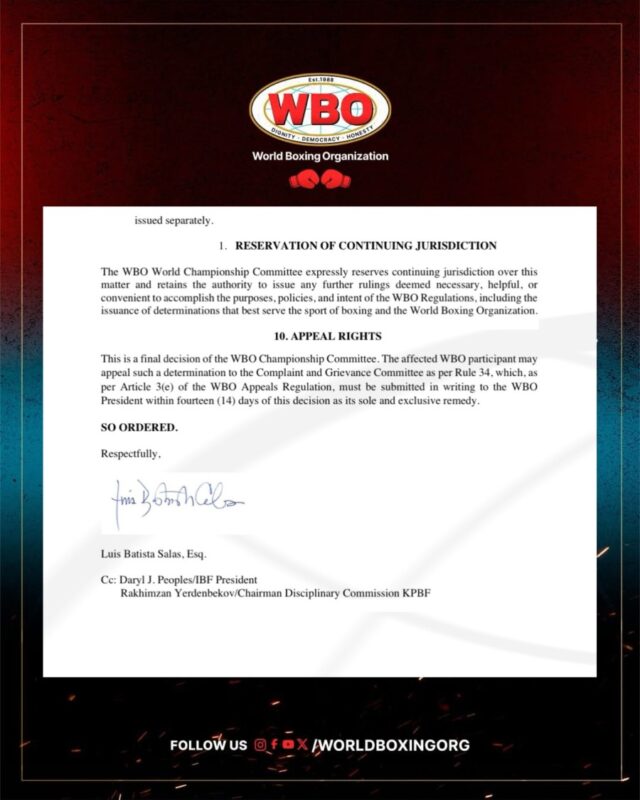
After reviewing the procedural history, including Show Cause notices and written submissions from Team Alimkhanuly, the Committee ordered a one-year suspension, retroactive to December 2, 2025.
As conditions tied to reinstatement and continued recognition as champion, Alimkhanuly must undergo comprehensive year-round random testing through a WADA-certified anti-doping program, with results certified and reported directly to the WBO.
He must also complete a mandatory anti-doping education program. The ruling states that all costs associated with testing and education are to be paid by the fighter.
Crucially, the resolution acknowledges that vacating the WBO Middleweight Championship was under consideration.
The Committee chose suspension instead, leaving Alimkhanuly recognized as champion during the ban.
Interim Title Ordered, Mandatory Fight On Return
To keep the division moving, the WBO authorized an interim middleweight title fight between its top two-rated contenders.
The resolution states that, upon the suspension’s expiration, Alimkhanuly must face the interim champion immediately to end the interim status.
No intervening bouts are permitted.
The WBO also notes its process operates independently of any separate governmental or federation proceedings tied to the same matter.
A Decision That Will Be Debated
This is where the WBO is going to take heat.
Alimkhanuly previously denied any wrongdoing when news of the adverse finding first surfaced.
“I will always support clean sports. Y’all better know this. You also know that I promote clean sports. I am surprised to read the news. VADA was analyzed for the first time and said that everything is clear. I haven’t made any changes to my vitamins or my diet.
“I don’t understand why this happened on the second test, we requested a reconsideration. We are waiting for answers!”
Those comments were made before the WBO confirmed the B-sample and issued its final ruling.
The ruling confirms the presence of the prohibited substance in both samples and relies on strict liability, which places responsibility on the athlete regardless of how the substance entered the body.
On that basis alone, some will argue that stripping the title would have been the clearest example to set.
At the same time, doping cases are rarely cut-and-dried in the court of public opinion. Fighters can dispute circumstances, and proving deliberate intent is often difficult even when the rules don’t require it.
The WBO appears to have aimed for a middle road: a firm suspension with heavy compliance measures, while stopping short of vacating the belt.
Either way, the decision now shapes the middleweight division for the next year, with an interim champion set to be crowned and a mandated fight waiting for Alimkhanuly when the suspension ends.
About the Author
Phil Jay is the Editor-in-Chief of World Boxing News (WBN) and a veteran boxing reporter with 15+ years of experience. He has interviewed world champions, broken international exclusives, and reported ringside since 2010. Read full bio.