SCOTTSDALE, Ariz. — Inside Driveline’s 15,000-square-foot facility, two racks holding 16 broken baseball bats hang on a wall, displayed like a valuable piece of modern art. Driveline, the cutting-edge player-development lab that has helped to revolutionize the sport at its highest levels, believes that offensive success in this era of pitcher dominance requires training in extreme conditions. The broken bats, then, are a badge of honor — a symbol of work done with requisite intensity.
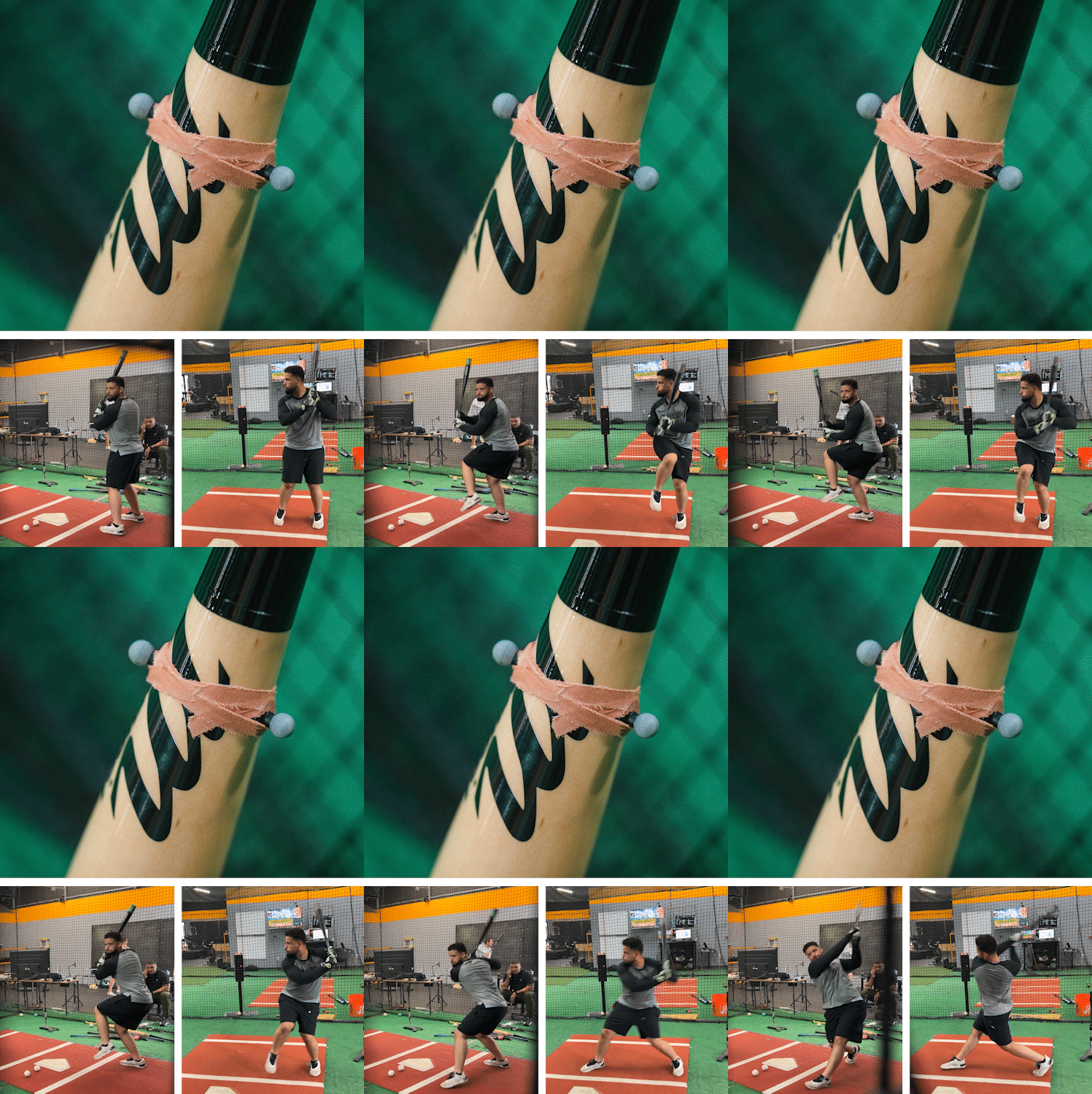
Early last week, Edgar Quero, a 22-year-old entering his second season with the Chicago White Sox, stepped into a batting cage only a few feet away. He placed reflective markers below the barrel of his 34-inch, 32-ounce Marucci bat and attached a Blast Motion sensor to its knob. He then stepped onto the cage’s sensor-equipped platforms, known as force plates, and took batting practice. Eight Edgertronic cameras captured his every movement.
Quero has one of baseball’s rarest, most valuable skill sets: a young, switch-hitting catcher with a promising offensive profile. He possesses an elite ability to stay within the strike zone and a knack for consistently meeting the baseball with the barrel of his bat, two skills exceedingly difficult to teach.
Inside Trajekt: Face any pitcher, any time
As pitchers throw harder and harder, hitters need every advantage they can get. Here’s what MLB is allowing during games — and how players feel about it. Alden Gonzalez »
And yet, there is so much more potential: Quero’s bat speed is slow, and his launch angle is subpar; two aspects that suppress his power numbers. And so Quero, competing for playing time with another young, promising White Sox catcher in Kyle Teel, made the 30-mile trek from his home in Peoria, Arizona, to an industrial section of Scottsdale. There, in the middle of a small strip mall, he spent two days navigating the onboarding process of Driveline’s hitting program, which has become a rite of passage among his peers.
About seven years ago, Driveline, which now operates facilities in three states, established itself as one of the innovators of a pitching renaissance throughout Major League Baseball, leveraging advanced technology to help pitchers tap into unprecedented velocity and movement. The scales were tilted as a result. Now, Driveline is using its biomechanical data and innovative training techniques to help hitters fight back and bridge a gap that has grown too wide.
It’s an irony Tanner Stokey, Driveline’s 32-year-old director of hitting, thinks about “every day of my life.”
“It’s never been harder to hit,” he said, “and the people who work for and have worked here have played a major role in that.”
THERE IS A rather large segment of retired major league hitters, not to mention a wide swath of fans, who rail against what they perceive as an industry-wide obsession with bat speed and launch angle, two of Driveline’s bedrock principles. They blame those pursuits — and, ultimately, the chase for slug — for the low batting averages and high strikeout rates that have significantly reduced the number of balls in play and, in their eyes, made the sport too homogenous and less appealing.
Four of MLB’s seven lowest full-season batting averages have come since 2021, the others taking place in the dead-ball era at the turn of the last century and in the lead-up to the pitcher’s mound being lowered in the late 1960s. The 18 highest strikeout rates in history, meanwhile, have occurred in the past 18 seasons.
In truth, these numbers say more about pitching than hitting. The average fastball velocity has increased steadily in the pitch-tracking era, from 91.3 mph in 2008 to 94.4 mph in 2025.
But it’s not just that pitchers throw harder and nastier than ever, Stokey believes. It’s that the technology favors them so heavily that they can often make drastic improvements to their spin rate or pitch profiles — or invent a new pitch entirely — from one start to the next. Detailed scouting reports aided by Hawk-Eye data are layered onto that, providing them with a clear vision for how to attack opposing hitters.
“And while it’s easier for pitchers to get better, it’s also become more and more clear what makes the most successful hitters,” Stokey said. “It’s very obvious that hitting the ball hard is directly correlated with offensive success. The harder you hit the ball, the higher likelihood it’s going to get through the infield, the higher likelihood it’s going to get past an infielder, the higher likelihood it’s going to be an extra-base hit or a home run. That being said, your launch angle is really important. Take that a step further, your attack angle and your bat path, all those things, are really important.”
Bat speed and launch angle don’t exist in a vacuum, though. They must be presented within the proper context, backed by precise biomechanical data and implemented strategically. Applying them correctly requires an understanding of how they’re maximized. And that’s where the improvement is truly taking place, both in facilities such as Driveline’s and outside of them, as advanced analytics trickle into the amateur levels and alumni of data-driven companies infiltrate the professional ranks.
Close to 100 former Driveline employees are now sprinkled throughout major league organizations, Stokey said, a quarter of whom came from the hitting side. The Boston Red Sox employ a dozen of them, including Kyle Boddy, a front office advisor who started the company roughly 15 years ago.
“Players younger and younger are getting exposed to this stuff faster,” Stokey said. “So, you’re starting to see the minor league players that are recently drafted, they spent the last four or five years of their lives hitting with HitTrax, using a Blast sensor, using pitching machines that mix pitches. They’re more comfortable and familiar with the information, so as they come up, they want that.”
A DRY-ERASE BOARD in the weight room of Driveline’s Scottdale facility lists leaderboards for professional, collegiate and high school athletes in an assortment of measurements from its dual force-plate system. Arizona Diamondbacks outfielder Corbin Carroll, one of their most distinguished clients, boasts the highest squat jump at 61.2 centimeters. Los Angeles Angels outfielder Jo Adell ranks third with a 60.1-centimeter countermovement jump (basically a squat jump with more help from one’s upper body).
Quero began his session on a training table a little after 2 p.m. on Jan. 20, where his range of motion was tested. Then he took his turn on the force plates, executing a series of jumps before exploding off a push-up position. The tests measure force — the totality of it, but also how quickly it’s generated and reproduced — and feed into a model that calculates expected bat speed and pitch velocity with a margin for error between 1 and 1.5 mph. A big differential between expected numbers and actual ones often indicates movement inefficiencies.
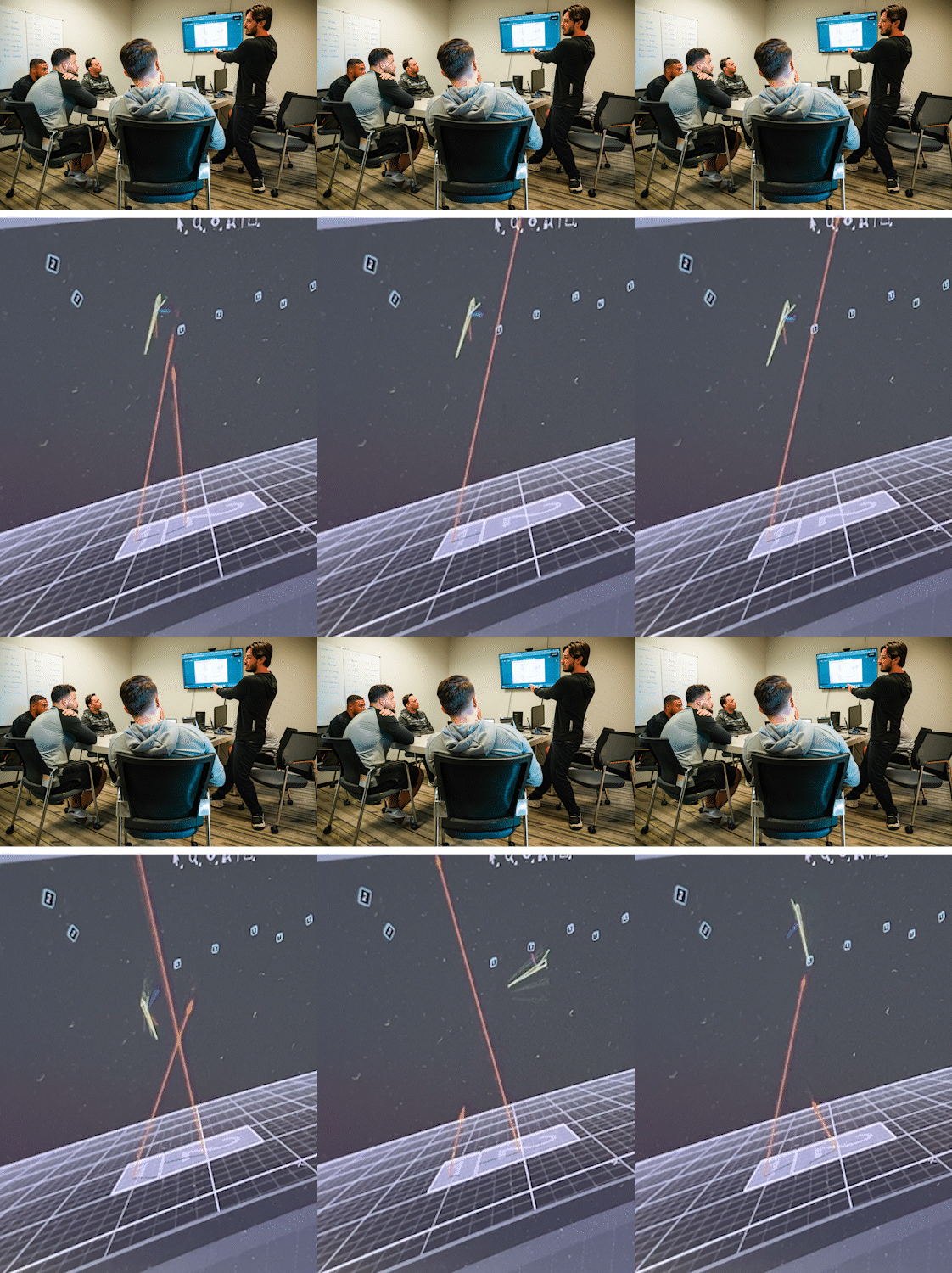
Those inefficiencies were tracked moments later, when Quero settled into a cage to hit baseballs traveling 65 mph from 42 feet away. The reflective markers near his barrel tracked his bat path, the Blast Motion sensor spit out bat-speed and attack-angle data, force plates measured the power he asserted into the ground, and Edgertronic cameras analyzed his swing mechanics at up to 17,000 frames per second.
Top MLB prospects for 2026

Where do stars of tomorrow like Konnor Griffin and Kevin McGonigle land as we rank baseball’s best young players?Top 100 prospects » | 101-200 »Ranking all 30 MLB farm systems »
Quero, who turns 23 in April, slashed .268/.333/.356 with five home runs in 403 plate appearances as a rookie with the rebuilding White Sox last season, making 66 of his 94 starts at catcher. He was far better against lefties (.852 OPS) than righties (.602). His July and August (.314/.373/.488 slash line) were good; his September (.218/.274/.269) was not. His average launch angle and bat speed both finished within the bottom 7% of the sport.
“Too much around the ball,” Quero said. “Too many ground balls.”
Quero was born in Cuba, an impoverished, baseball-loving island that does not possess any of the advanced data that now proliferates the sport in America. He defected to Haiti in 2019, then traveled to the Dominican Republic a couple of weeks later. He trained there until 2021, when he signed with the Angels for $200,000. In an effort to maximize what would be their final stretch with Shohei Ohtani in summer 2023, the Angels traded Quero to the Chicago White Sox for veteran pitchers Lucas Giolito and Reynaldo Lopez. The White Sox later stressed to Quero the need to improve on his pitch framing and bat speed, spurring an interest in analytics.
“This is a different baseball, and it’s part of the game right now,” Quero said. “You have to learn it.”
DRIVELINE’S HITTING PROGRAM took off because of Ohtani.
In May 2018, Stokey left his role as hitting coach at Arizona Christian University to take a job at Driveline, whose hitting division had sprouted only a year and a half earlier. Driveline was known almost exclusively as a pitching lab. But that perception began to change in fall 2020, when Ohtani embarked on the most important offseason of his career.
The COVID-19-shortened season had proven to be a disaster for the aspiring two-way star. Ohtani, then with the Angels, had fully recovered from his first Tommy John surgery but was nowhere near ready to perform at his peak. On the mound, he could barely throw strikes. In the batter’s box, he often seemed lost. And so in the first full week of October, Ohtani visited Driveline’s base of operations in Kent, Washington. He was there to work on his pitching, but he agreed to give their hitting program a try.
Stat that will define 2026 for every MLB team
Here are the numbers that could make — or break — your favorite squad in the new year.National League » | American League »
Every day until Halloween, Ohtani and Stokey worked together in the batting cage. Ohtani needed a new foundation. He was overcoiled. His hip rotation was late, his front foot slid upon meeting the ground and his bat was too vertical at the point of contact, prompting him to spin off pitches frequently and making it extremely difficult to pull baseballs into the air. But his bat speed was elite, his power was prodigious, and often, that was enough.
In one month, Ohtani broke three of Driveline’s composite-based speed-training bats. On numerous occasions, Stokey would shake his head at Ohtani mishitting a pitch and slicing it to the opposite field, only to glance at the batted-ball data and learn it traveled more than 100 mph.
“It was honestly something that changed my perspective as a hitting coach,” Stokey said. By the end of it, Stokey told his staff that he hoped Ohtani would compile enough at-bats to reach the 30-homer threshold the following season. Ohtani hit 33 by the All-Star break, the beginning of a run that saw him win four unanimous Most Valuable Player awards in a five-year stretch. His success inspired curiosity.
“Word spreads quickly in the game,” said Stokey, who estimates that as many as 40 major league hitters have since used the facility to some extent. “It was clearly a thing where we weren’t allowed to talk about him. We didn’t put anything out. But inside the game, people knew he was here. That was one of the big things that started to push it.”
FIVE OFFSEASONS LATER, Quero was in a conference room with Stokey, hitting coordinator Jacob Hirsh, high-performance coordinator Tyler Kozlowski and two of Quero’s agents from Ballengee Group. For a little more than an hour, every aspect of Quero’s swing and approach was dissected through a variety of metrics, tables and line graphs outlined in two PDF files that totalled 23 pages. One figure stood out:
67.5 mph.
That was the average velocity of Quero’s bat speed last season, ranked 217th among 226 qualifiers. Just as Driveline’s pitching program is dedicated largely to maximizing a pitcher’s velocity, its hitting program mostly centers on maximizing bat speed. The reason was contextualized early in the meeting: Every one mph of bat speed, Quero was told, equates to 1.2 mph of exit velocity, which translates to 7 feet of additional batted-ball distance.
Quero was shown a chart of comparable players based on his batted-ball profile last year, displaying more contact-oriented hitters such as Eddie Rosario, Alex Verdugo and Bryson Stott. Then, he was shown his realistic potential: Josh Naylor, Jazz Chisholm Jr. and Addison Barger, players with far more power.
“If we kept everything in your profile exactly the same, but we added 2 miles per hour of bat speed alone, you’re looking at being more like that type of hitter,” Hirsh told him. “And a couple of these guys made a lot of money very recently.”
Getting there requires a multifaceted approach.
It began with Kozlowski’s assessment, which found that the power Quero generated through his countermovement and squat jumps off the force plates, the biggest indicator of potential bat speed, was significantly below the major league average. His upper body is strong, as evidenced by the results of the plyometric push-up drill, but his lower-body explosiveness needs work.
“Getting these up, the power numbers up, should help your bat speed increase,” Kozlowski said. “It’ll give you a lot more juice.”
Another issue stemmed from his point of contact, which occurred around the middle of home plate. From the right side, Quero hit the ball 8.5 inches deeper than the major league average. From the left side, the difference was more than a foot. To improve, Quero needs to hit pitches way more forward.
“The deeper you catch the ball, the less time you have to accelerate the bat,” Hirsh said. “The further out in front you’re able to catch the baseball, the more time you have to get the barrel moving faster.”
Quero swung at only 18.6% of the pitches he saw outside the strike zone last season, the seventh-lowest mark among the 215 players who compiled at least 400 plate appearances. His squared-up rate — a measure of a hitter’s ability to maximize exit velocity based on bat and pitch speed, usually by hitting pitches on the heart of the barrel — finished within the top 5% of the sport.
But his launch angle on the top 10% of his hardest hit balls was 1.5 degrees from the left side and 0.3 degrees on the right side, a far cry from the league average of 12 degrees. On pitches he pulled as a left-handed hitter, his launch angle was minus-8.5, a sign that his swing goes uphill too early, prompting him to scrape the top of the baseball and beat it into the ground.
Stokey called it “a recipe for not being productive,” and the fix lies in the biomechanical data.
Editor’s Picks
2 Related
Graphs display the angle and rotational velocity of Quero’s pelvis and torso as well as the angle of his swing planes, matching them with ideal paths. They show his front hip opening up too early, which in baseball terms is referred to as “leaking out.” Ideally, his pelvis would stay coiled longer and his front foot would rotate into the ground late and fast, generating more speed in his pelvis and sending it up the kinetic chain — into the torso, the arms, the hands and eventually the barrel. But Quero’s pelvis rotates too slowly. “And because they’re moving slow,” Hirsh said, “everything else starts to outrace your hips to the baseball.”
The result is a steep, negative attack angle.
Attack angle — the point at which the bat and baseball meet — is not a consistent barometer of success. An ideal attack angle resides somewhere between 5 and 20 degrees.
That’s not a universal truth: One of the game’s best hitters, Toronto Blue Jays first baseman Vladimir Guerrero Jr., had an attack angle of 1 degree last season, last in the majors. But he coupled it with some of the game’s best swing decisions, contact skills and bat speed, triggering top-tier exit velocities.
Quero’s inability to produce those bat speeds makes pulling the ball in the air more crucial. Last year, he did that on only 7.8% of his batted balls.
IMPLEMENTATION BEGAN BY placing Quero in a foreign position: hitting same-side breaking balls, the type of pitch he never encounters as a switch-hitter. The purpose was to force him to stay closed with his hips. Leaking out would prompt him to spin off pitches and yield bad results.
Quero used an assortment of training bats with different weights, distributions and lengths as he navigated three unconventional drills. In one, he stood 30 degrees open, forcing an overly exaggerated coil into his back hip. In another, he turned his entire body toward the pitcher’s mound, then stepped back into his hitting position and took his swing in one motion, throwing chaos into his attempts to control movement. In another, named the “Big Papi” drill, Quero loaded the way Hall of Fame designated hitter David Ortiz used to — simultaneously raising his front foot and lowering his hands before separating and starting his swing.
When the smoke cleared, another flaw was noticed.
“You’re so used to catching the ball deep [in the batter’s box],” Hirsh told Quero in the batting cage, “you almost don’t know what to do when you catch it out in front. As you get past the point where you normally make contact, you’re like, ‘Oh s—, this is new to me.’ Sometimes, you get this posture breakdown, start to come up out of your legs, because at this point, you’ve already made contact. You’re done. So, it’s just more training, more reps, being comfortable being able to catch the ball in front, and your body’s going to make the adjustment on its own.”
Driveline opened its Scottsdale facility in 2022 and unveiled another in Tampa two years later, giving the company satellite locations in the two states where a large segment of players spend their offseasons. A two-day assessment like Quero’s costs $7,500 for professionals. A full offseason program runs $15,000. The full-year package, which includes advanced-scouting reports, stretches to $20,000.
Driveline prefers that hitters — and pitchers — begin working with them at the start of their offseason, seeing it as the ideal time for assessment. Quero, though, arrived three weeks before the start of spring training. The hope is that he implements some of the drill work, sees results show up throughout his sophomore season and returns this fall, at which point, the staff believes, more significant gains can be had.
“I was happy to be here,” Quero said, “to know my body a little bit more. I think it’s going to help me during the season, trying to get more of my exit velo up and bat speed and launch angle a little bit better.”