NEW YORK — It’s annoyingly cold, a gray day after a fool’s spring, but most of the Atlanta Hawks have dispersed into the city, anyway.
The team arrived from Orlando about 3 a.m., and the 78th game of the season is tomorrow night in Brooklyn. Technically, it’s supposed to be an afternoon off.
Advertisement
Yet, here in a windowless conference room on the third floor of the Ritz-Carlton NoMad, general manager Onsi Saleh and head coach Quin Snyder are busy sketching out hypothetical three-man actions on a dry erase board.
They don’t necessarily need to be doing this. There are 10 days left in the NBA regular season and the Hawks are already the hottest team in the Eastern Conference, the squad no one wants to face in the playoffs.
But this team is still somewhat new, still somewhat unresolved. And so, the architects of this revival are chasing refinements, trying to uncover some combination, some scheme that will unlock this group’s full potential.
This is, after all, a team that has traded nine players since July. It’s a team that has asked its players — young and old — to constantly reinvent themselves.
Advertisement
“We like to say: they’re rookies in their roles,” Snyder says. “This is all new for them. We’re still learning about them. And they’re still learning about–”
“Each other, yeah,” Saleh cuts in, finishing the thought. “And us, honestly.”
Throughout a wide-ranging, 45-minute conversation with USA TODAY Sports, Saleh and Snyder opened up about their philosophies on roster construction and culture, on their expectations, on success.


The most tectonic of those trades was the one that shipped former franchise cornerstone Trae Young to the Wizards. It was a risk that has paid off.
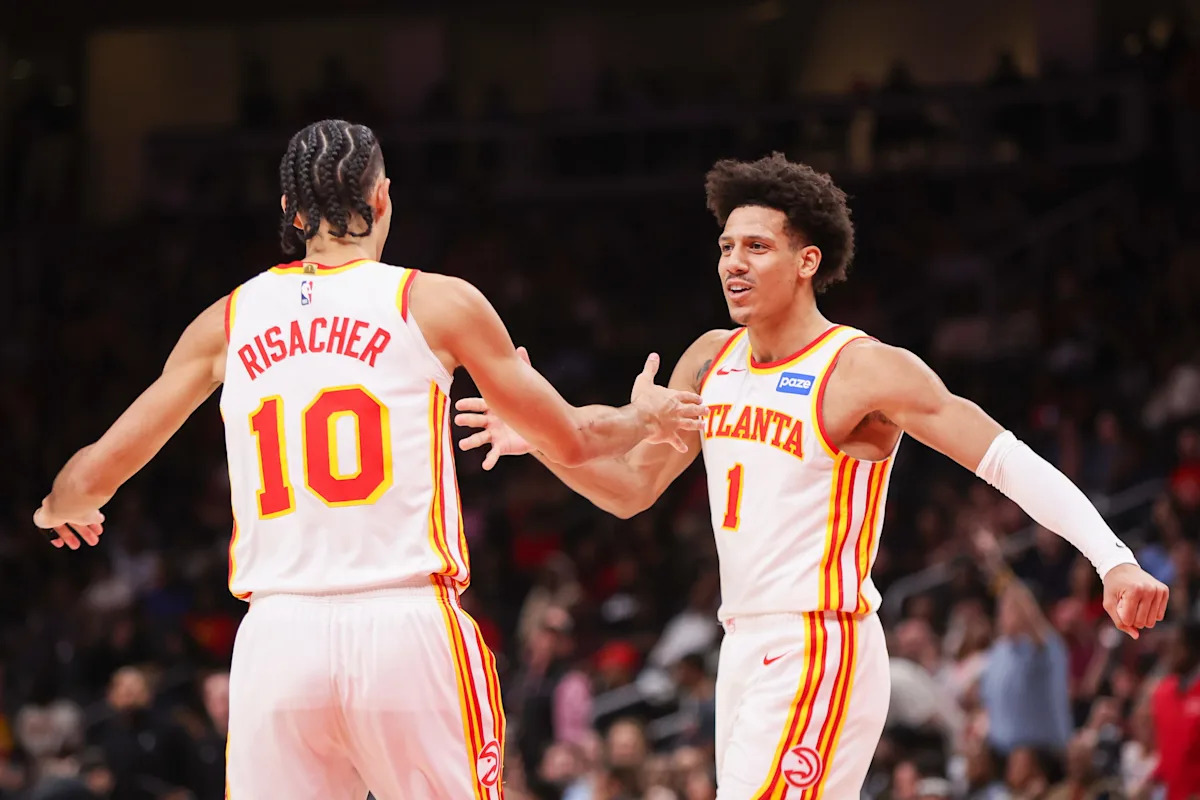
First-time All-Star Jalen Johnson has blossomed into an elite, play-making forward who can push the ball in transition. Nickeil Alexander-Walker, the target of a June 2025 sign-and-trade with the Minnesota Timberwolves, has emerged as a dangerous offensive threat and is shooting 49.2% from beyond the arc over his last 15 games.
Advertisement
It took work to get here. Atlanta has played 24 different starting lineups this season. Players have come and gone, and roles have shifted week-to-week and game-to-game.
“It has been a rollercoaster,” Alexander-Walker told USA TODAY Sports. “But it has been the normal process of anything that comes with a form of success. Trades happen, injuries happen, so you’re in and out of rotations. You have to try and get a feel for consistency.
“It has been a lot of moving parts. For me, I expect the moving parts now, so it’s easier than trying to meet the same cadence every day because it’s too hard to do.”
Fluidity, cohesion become Hawks staples in post-Trae Young world
At the All-Star break, the Hawks were 26-30 and in 10th place in the East. A fourth consecutive trip to the Play-In Tournament appeared certain.
Advertisement
Yet, with so many new players to incorporate, Saleh and Snyder spent much of that week off with one question in mind: what tactical changes needed to happen to get this team to thrive?
Atlanta prioritized its versatility, its length and athleticism at the wing and realized that, with Young gone, the ball could flow to several pockets of energy on the floor.

Dallas Mavericks forward P.J. Washington (25) fights for a loose ball with Atlanta Hawks forward Jalen Johnson (1) and forward Onyeka Okongwu (17) in the fourth quarter at State Farm Arena on March 10, 2026, in Atlanta.
In a way, the Hawks almost deemphasized the point guard position, choosing instead to empower four of their five starters — Johnson, Alexander-Walker, Dyson Daniels and CJ McCollum — to be primary ball handlers.
The day before their first game after the break, a Feb. 19 showdown at the 76ers, the Hawks held a team meeting. Saleh and Snyder harped on fluidity and cohesion. They shared their vision.
Advertisement
“It was pretty significant,” Snyder said. “It was really to address opportunity, how this team was going to function. That stands out because it was kind of like an understanding amongst our whole group that we’re going to double down on some things and guys were going to have to buy into it.
“The larger theme from it was: what are the sacrifices that everybody is willing to make for the group? But you can only present something, and they can take it or leave it. How deeply do they buy in?”
Since that meeting in Philadelphia, Atlanta has gone 19-4 through April 7. No team in the East has a better winning percentage (.826) over that stretch.
The meeting unlocked a complementary style of play, where ball pressure from Daniels and Alexander-Walker could launch Johnson’s play-making ability in transition. The offense became almost amorphous and intuitive. Rather than run plays, Snyder started asking his players to play out of concepts, to read and intuit the game, to feed off of each other.
Advertisement
Despite the roster turnover, the Hawks are averaging an NBA-best 30.3 assists per game, tied for eighth-most all-time.
Awards races: MVP power rankings by odds: Who’s the favorite after Wembanyama injury?
Saleh and Snyder have relied on open dialogue with their players. They’re emphasizing transparency, explaining their thoughts and reasons for any tactical shifts. Taking that one step further, they’re pushing their veterans to expand their games to better fit the collective.
This is the first time that Johnson has become the unquestioned star of a team.
Alexander-Walker, previously thought of as a role-playing defensive specialist, has seen his on-ball usage and scoring explode; this year, he’s averaging 20.8 points per game, up from 9.4 last season with the Timberwolves.
Advertisement
Center Onyeka Okongwu has been given the green light to shoot 3s; this season, he’s hitting them at a career-high 37.7% clip and has seen his attempts per game more than double from 2.0 to 5.3.
McCollum came to Atlanta in January in the Young trade having recorded 786 consecutive starts, a streak that spanned more than 10 seasons. It was snapped when Snyder initially asked McCollum to come off the bench. McCollum didn’t question the move.

Apr 6, 2026; Atlanta, Georgia, USA; Atlanta Hawks guard CJ McCollum (3) reacts after making a shot from beyond half court that would have tied the game but was ruled after time expired against the New York Knicks during the second half at State Farm Arena. Mandatory Credit: Dale Zanine-Imagn Images
“I pride myself on being a chameleon,” McCollum told USA TODAY Sports. “A guy that can play different roles, a guy that has a unique skill set that can fit any scheme, any genre, any group of personnel. For us, it’s just about doing whatever it takes to win.”
Advertisement
Dinners on the road and soccer friendlies strengthen Hawks bonds
When on the road, NBA teams typically organize team dinners. A staffer will scout worthy restaurants and set up reservations. The team will handle transportation and logistics.
For one, it gives the team some control over the quality of meals players eat while on the road. For another, it helps build camaraderie and morale.
This season, attendance at Hawks team dinners has increased significantly, with players frequently encouraging others to attend.
That’s not the only way the Hawks are connecting. Their recent road schedule lined up so that two off days, March 26 (Brazil-France, in Boston) and March 31 (Brazil-Croatia, in Orlando), coincided with a pair of men’s soccer international friendlies. Players organized the outing, and nearly the entire team attended the former.
Advertisement
The team has also leaned into a worship group before games. Prior to their April 3 game against the Nets, all but one of the Hawks players in the locker room went to a makeshift chapel for a quick pre-game prayer.
Playoffs: How does NBA Play-In Tournament work? Format and current standings
“It’s a great group of guys,” Alexander-Walker said. “I was very shy and nervous when I first met them. I was like, ‘I just hope everyone likes me.’ It was important for me to have a team that was connected and to be a part of something.
“I’m the new guy here. And some of these guys have been here before me, some guys had established their own versions of their roles here. So whether that was stepping up or taking a step back, but to make room for me, I really appreciate that.”
Advertisement
Although this isn’t necessarily rare or uncommon in the NBA, it tends to be the sign of a healthy and cohesive locker room.
Midway through the fourth quarter during an April 1 game against the Magic, the Hawks were up by 21 when Magic forward Goga Bitadze yanked backup Hawks center Jock Landale toward the floor as Landale was going up for a lay-in.

Atlanta Hawks forward Jonathan Kuminga (0) and guard Dyson Daniels (5) react to a foul by Orlando Magic center Goga Bitadze (35) in the fourth quarter at Kia Center on April 1, 2026, in Orlando.
Landale fell awkwardly and sprained his ankle, an injury that will sideline him at least two weeks. Immediately after Landale thudded on the court and was writhing in pain, the four other Hawks on the floor rushed over to confront Bitadze. Daniels came all the way from behind the 3-point to get a shove in on Bitadze.
Advertisement
For Saleh and Snyder, it was something of a culmination.
“It was an angry moment,” Saleh said. “It was a frustrating moment at the time, but when that happened, four guys sprinted.
“I watched it maybe 10 times. And I’m proud of it. It shows that they’re connected and trying to be there for each other. That’s the culture we want. It’s a testament to this group and it shows, to what Quin was saying, the sum is greater than the parts here.”
This article originally appeared on USA TODAY: Atlanta Hawks gel after Trae Young trade, eye deep NBA playoff run