This article was first published in the Ute Insiders newsletter. Sign up to receive the newsletter in your inbox each Wednesday night.
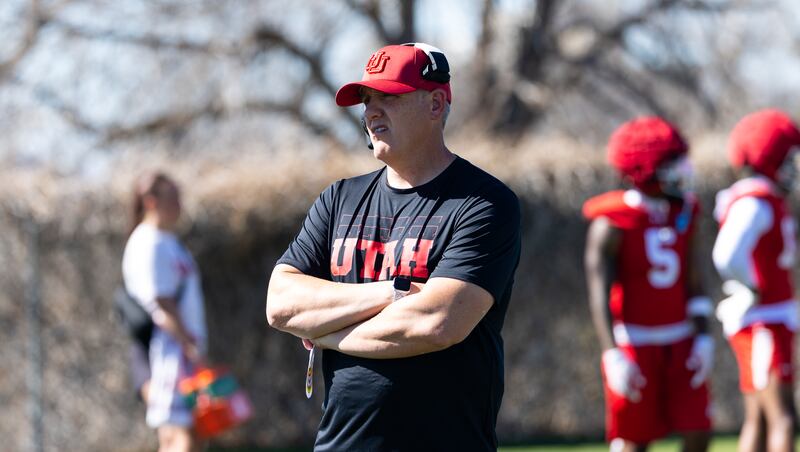
Utah head coach Morgan Scalley wants the Utes’ offense to be innovative and able to stress the defense.
Advertisement
While some might point to Utah’s passing offense opening up more under Scalley in the Las Vegas Bowl compared to the Kyle Whittingham-led years — quarterback Devon Dampier threw for 310 yards and two touchdowns in Utah’s win over Nebraska — the Utes’ new head man is quick to mention that an innovative offense doesn’t have to be pass-heavy.
“I have never said that I want it to be a pass-happy (offense) … I want to dominate the line of scrimmage, I want to be innovative, and I want to stress defensive coordinators,” Scalley said.
Like most schools with a new offensive coordinator, Utah is keeping the specifications of OC Kevin McGiven’s offense under wraps, though fans can expect a spread offense that takes advantage of the personnel Utah has.
Though McGiven will have his own spin on things, Utah’s offense could look similar to what Jason Beck ran last season, which was a selling point in the hire.
Advertisement
“That’s the beauty is you pull that film up and go, ‘Look boys, doesn’t that look similar?’” Scalley said in his January introductory press conference.
“I have never said that I want it to be a pass-happy (offense) … I want to dominate the line of scrimmage, I want to be innovative, and I want to stress defensive coordinators.”
Utah coach Morgan Scalley
In 2025, McGiven’s offense at Utah State leaned into former Ute QB Bryson Barnes’ rushing ability and decision-making in the run-pass option. He can utilize a similar scheme with Dampier, who rushed for 835 yards and 10 touchdowns and threw for 2,490 yards and 24 scores in Beck’s offense.
McGiven’s offenses, from his time at Weber State to last year in Logan, have always been adaptable to his personnel, and with the strengths of Dampier and backup quarterback Byrd Ficklin being their running abilities, expect to see a good amount of RPO and designed quarterback runs in McGiven’s scheme this season.
“Everybody knows how athletic Devon and Byrd are and I know that that’s something that we’ll be able to lean on,” McGiven said. “That’s not a secret with their athleticism where you can utilize that. They can get you out of certain situations. It’s always nice as a play-caller.”
Dampier helped turn Utah’s offense around while playing injured much of the season, and while he improved as a passer in 2025, McGiven believes he still can improve more in 2026.
Advertisement
“Developing the total quarterback. And I think the biggest thing with their development, probably with the system and schematics of the system is just developing their decision making, developing their processes,” McGiven said. “Reads, going from maybe where he’s got an object receiver, it’s like ‘throw to this guy’, and then all of a sudden you’re going through a full-field progression with certain concepts just because of what the system requires you to do.”
So far, Dampier and Ficklin have adapted well to McGiven’s scheme and are ahead of schedule.
Both players received offers to play elsewhere, but even with the coaching and offensive coordinator changes, both decided to stay put at Utah.
What was McGiven’s sales pitch?
Advertisement
“I think a big thing with Devon was selling the development and this is what I’ve had guys do. These are similar players to you and what they’ve been able to accomplish. It’s a goal of his to go to the NFL and so, OK, how do we need to develop you to get you to the next level?” McGiven said. “We need to get you more in tune with protection. We need to get you more in tune with certain types of reads, with certain types of concepts so that you can become more of a complete player.”
“I think with Byrd, it’s utilization. How can you contribute and what does that look like? He’s like a Swiss army knife and without giving up the ship, there’s a lot of different things that he can do on a play-to-play basis and different places that he can line up. And we need to be able to utilize those and get creative with those packages.”
Utah quarterback Byrd Ficklin (15) celebrates his touchdown against the Kansas State Wildcats during an NCAA football game held at Rice-Eccles Stadium in Salt Lake City on Saturday, Nov. 22, 2025. | Isaac Hale, Deseret News
Under Whittingham, Utah was known for a run-heavy style of play. Last season, with a strong offensive line, the Utes set school records for rushing yards and rushing touchdowns.
Advertisement
Scalley has not given his offensive coordinator a directive to run the ball, but McGiven understands that Utah has been successful running the ball in the past, and with Dampier and running back Wayshawn Parker, the Utes once again have the personnel to gain on the ground — given the new offensive line can perform well.
“I think an important component of what it’s been in the past is the ability to play complementary football. And regardless of what it’s looked like from year to year, my understanding of what this place is, what we’ve been able to lean on to be able to win football games, to win with complementary football … I’m well aware of those things, but that’s never been a directive with (Scalley),” McGiven said.
Speaking of the offensive line, which is replacing every starter from last year’s team under new coach Jordan Gross, McGiven said that he was initially “skeptical” of the group.
“Yes, there were some starts. Yes, there was some experience, but kind of spotty. Collectively as a group, no starts together,” McGiven said.
Advertisement
It’s still early — Utah is in just Week 2 of spring ball — but McGiven has liked what he’s seen from the group.

New Utah offensive coordinator Jordan Gross claps during Utah-BYU basketball game at the Huntsman Center in Salt Lake City, Utah on Saturday, Jan. 10, 2026. | Sophia Kuder, Utah Athletics
“Coach Gross is a technician and I see those guys working on their craft every day. I see the room becoming closer, bonding. I’m seeing leadership come out of that room. So well ahead of schedule, we got to decide on who the best five are there,” McGiven said.
The starters in the quarterback and running back rooms are already established, but in the two other “skill position” rooms — wide receiver and tight end — starting positions are up for grabs.
It’s reasonable to assume that Utah State transfer receiver Braden Pegan, who caught 60 passes for 926 yards and five touchdowns in McGiven’s offense last year, will be a starting receiver, if not WR1 in the Utes’ offense.
Advertisement
“He’s been able to be out there practicing at a high level because he’s confident in the system. And then I think this early on, I think part of him being both the leader on our team was the fact that he’s been able to bring guys along. He can sit in the receiver room and he can coach those guys up on what certain things need to look like and what this concept means,” McGiven said.
After Pegan, there’s a lot of players competing for time, including San Jose State transfer Kyri Shoels, Mississippi State transfer Ricky Johnson, and returners Larry Simmons, Creed Whittemore and Tobias Merriweather. There’s buzz that this could be Utah’s deepest receiver room in some time, but as always, it’ll be up to them to prove it.
The tight end position is another room undergoing significant change after losing Dallen Bentley to the NFL draft. Hunter Andrews, who showed promise before suffering an early season-ending injury, is a key piece, alongside Weber State transfer Noah Bennee and linebacker-turned-tight end Kana’i Lopes.
The “rhino” tight ends, 317-pound Semi Taulanga and 276-pound Sione Motuapuaka, are also exciting for McGiven to try and scheme into the offense.
Advertisement
“We got those two rhinos in there that I’m like, ‘OK, I haven’t really played with the rhino. These guys are really cool,’” McGiven said.
“I just know that they’re in there and they’re knocking people around. And so I’ve used a fullback in the past, last year at Utah State, a lot of two back and three back, but they were backs with different skill sets. And so whether you call them a tight end or fullback, how do you utilize those guys to the fullest extent? It’s a good problem to have. It’s fun, but early in the process of trying to do that.”
Though the offensive install began in winter workouts, it’s still fairly early on in the process, but McGiven is happy with the progress.
“Through Practice 4, it was two installs with two reviews. Still a lot of details. A lot of things we have to clean up, which is normal. It’s not frustrating. Just got to have a growth mindset and we got to take it with a grain of salt,” McGiven said.
Advertisement
“Trying to create chemistry with putting all 11 pieces together. But I think there are some really good elements, personnel-wise, to this offense and things that we’re tinkering with right now, trying to find roles to see what situations we can put guys in and who we can use and create packages around, things like that.”

Utah quarterback Devon Dampier runs to throw his promotional ball to the crowd during an NCAA basketball game between Utah and Houston held at the Huntsman Center in Salt Lake City on Tuesday, Feb. 10, 2026. | Isaac Hale, Deseret News
In case you missed it
Kyle Whittingham, through his agent, informed the University of Utah of his intent to return for the 2026 season, a public records request placed by the Deseret News revealed. Read the negotiations between Whittingham’s agent and the university prior to the winningest coach in Utah football history “stepping down.”
Advertisement
From the archives
Extra points
Utah wins second straight Big 12 championship, Avery Neff claims all-around title
Utah’s season comes to an end with WBIT loss against Eastern Kentucky
Spencer Fano, Caleb Lomu, Dallen Bentley among former Utes who shined at Utah’s pro day