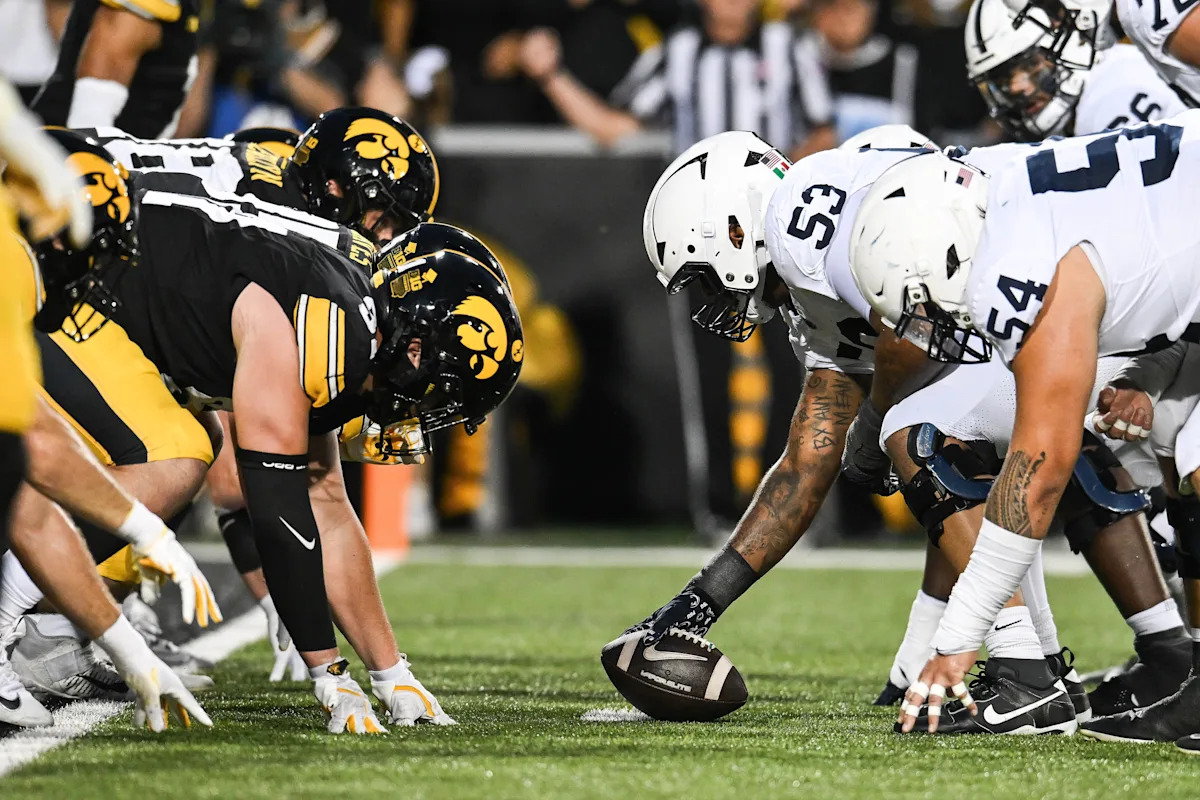
Changes around the punishment for targeting penalties and the enforcement of equipment rules such as pant length will be the top points of a major discussion this week when the NCAA Football Playing Rules Committee conducts its annual meeting at the NFL Scouting Combine to propose rules changes for the upcoming season.
According to multiple people briefed on the discussions, the committee could propose to remove the carryover suspension part of the punishment for first-time offenders on second-half targeting penalties, leaving in place a 15-yard penalty and ejection. Players flagged for targeting multiple times within the same season could be subject to harsher punishment. The rules committee will come up with proposals at its meetings Tuesday and Wednesday, then spend the next month gathering feedback before final decisions in March.
Currently, a player penalized for targeting in the second half of a game must sit out the first half of the next game. That affected this year’s national championship, when Miami cornerback Xavier Lucas was forced to sit out the first half against Indiana for a penalty he committed in the Fiesta Bowl semifinal against Ole Miss.
“We feel it was unjustly administered, and now it impacts the last game of the season,” Miami coach Mario Cristobal said before the title game.
The targeting penalty has drawn the ire of fans since it was introduced in 2008, but proponents say the rule has had its desired effect of dramatically lowering the number of head collisions. NCAA coordinator of officials Steve Shaw told The Athletic in 2024 that the penalty “is saving our game.” Officials also note the number of targeting penalties called has been decreasing over the last several years, from 0.27 per game in 2020 to 0.14 in 2024.
However, the punishments for the penalty have changed over the years. Originally, in 2008, it was just a 15-yard penalty. When the ejection element was added in 2013, the offending player also had to leave the sideline. Starting in 2019, players flagged for targeting three times in the same season received a full-game suspension. In 2020, the requirement to leave the sideline after being ejected was removed. The NCAA added an appeals process for second-half targeting ejections in 2022.
Now, the rules committee might propose removing that carryover suspension for first-time offenders, on the basis that an ejection is plenty harsh and doesn’t need to affect an unrelated game.
“Everybody’s done a tremendous job, and now it doesn’t feel like the punishment fits the crime, where the majority of these are just football plays,” said Dean Blandino, the Fox Sports rules analyst who serves as the NCAA director of replay and UFL vice president of officiating. “We’ll see if there’s enough impetus to get rid of the carryover, but the rule has worked.”
There remains little to no support for backing off of targeting itself or creating a two-tiered penalty system, as the coaches association proposed in 2019. That’s because it would make officiating the rule even more subjective, and college sports leaders (and their lawyers) are concerned pulling back on the penalty could be used in any potential future legal claims around head injuries.
“No one wants to de-emphasize what a targeting call is. Why mess with it if it’s working?” one person briefed on the situation said. “But I don’t think a guy in the next game recognizes (the severity) of the game before, or you have someone who has weeks off and then can’t play in the first half of the national championship.”
In a change this year, rules proposals will go to the Division I Football Oversight Committees for ratification in mid-March rather than to the Playing Rules Oversight Panel that previously approved changes in April.
Who wears short shorts?
The other big point of focus at the meeting will be seldom-enforced equipment rules for which the rules committee might propose the threat of an actual game penalty. One possibility is a warning for a first offense, followed by a charged timeout or a delay-of-game penalty if the offending team has no timeouts remaining.
The NCAA almost a decade ago passed rules to require pants to cover the knees, but players often don’t abide by that rule, and the “Daisy Dukes”-like shorts worn by some have drawn national attention. Lou Groza Award-winning Oklahoma kicker Tate Sandell leaned into the jokes, and his look prompted ESPN’s Kirk Herbstreit to say during last season’s Oklahoma-Tennessee broadcast that the style should be a penalty. NCAA officials have noticed.
“It’s embarrassing,” a second person briefed on the discussions said. “It’s been degrading every year. I don’t know how much higher his pants can go.”
The reason for the rule was twofold. One, officials don’t believe inconsistently short pants look good in a team sport. Two, short pants affect the placement of thigh pads and knee pads, making it a safety issue.
The pants rule hasn’t been enforced because nobody has cared to do it. Game officials have said they have too many other things to worry about. Coaches, too. Conferences haven’t stepped up to help with enforcement, either. The NFL has a specific official at games to monitor equipment violations before the game, and fines can be issued. College football does not have that.
“Let’s do something about the uniforms,” Colorado coach Deion Sanders said last summer. “We’ve got guys in biker shorts. That makes me sick because I’m a football guy — I played this game at a high level, and I have so much respect for this game. How can we allow guys out there in biker shorts, no knee pads, no nothing, literally pants up under their thighs, and that’s cool?”
It’s not just pants, either. Players increasingly attach multiple mouthguards to their helmets and don’t use either of them. The NCAA in 2015 banned players from wearing short jerseys that expose their abs, but that trend has popped back up.
If the rules committee proposes in-game penalties for equipment violations, it could fall on the game officials or the replay center to call them out. The hope would be that a handful of penalties early in the season might be enough to stop the trends.
College officials believe that approach worked with the rule around faking injuries introduced last season: If a player went down after the ball was spotted for the next play, his team was penalized a timeout. Although there were instances in which teams lost timeouts for legitimately injured players, officials do believe the faking of injuries decreased as the season went on.
But again, equipment penalties require someone willing to enforce them.
“Nobody wants to be the wardrobe police,” the first person said. “I don’t know where that one is going to go.”
Another rule discussion will involve punt team jersey numbers. Multiple people briefed on the discussions pointed to a rising trend of teams exploiting a loophole by which players on the offensive line for a punt are not required to wear a jersey number from 50 to 79, leading to sneaky fake punt plays. Officials say the loophole makes the play extremely difficult to properly officiate and for an opposing coach to recognize. In a different kind of play, the Big Ten last season said a fake punt in which USC put a backup quarterback in the starting punter’s jersey number should’ve been flagged as an unfair tactic.
There are also expected to be discussions about a coach challenge or hybrid replay system, but past efforts to move to a less-involved replay system have not gained much traction.