
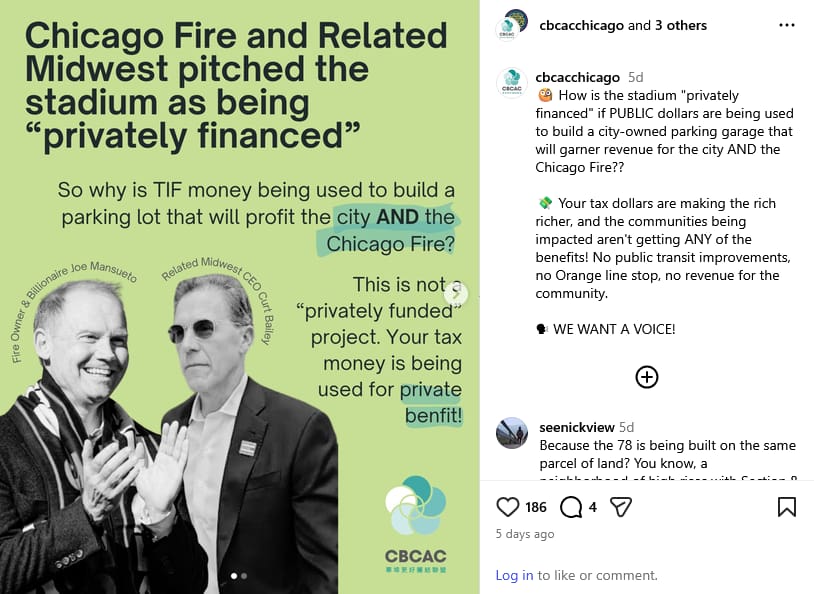
Last year, the owner of the Chicago Fire, Joe Mansueto, announced that the MLS club was moving forward with plans to build a new stadium. While the costs varied between $650M and $750M, the stadium would be “privately-funded,” according to Mansueto. Local media and other news outlets praised Mansueto for not forcing costs onto taxpayers.
“My personal view is that stadiums are not a great investment…They’re big, costly to maintain, sit empty most of the time. And so to the extent that they create value, most of that accrues to the sports team, not the municipality. So to me, it’s fair that the sports team should own it. Moreover, here in Illinois, in the City of Chicago, our finances are strained. Teachers want more money, law enforcement needs money, pension obligations. Our city and state don’t have the funds, to be candid, and so to me, we would privately finance it.” — Joe Mansueto, New York Times, 10/17/24
The Chicago Sun-Times called Mansueto an “outlier among Chicago sports moguls for his willingness to bankroll his own…$750 million stadium”. Other news outlets claimed that thanks to Mansueto, the stadium could now be built “at no cost to the taxpayers and the city.” Yahoo Finance wrote that because Mansueto was “self-funding a…new stadium”, he would therefore be able to “side-step red tape and bureaucracy” because he wasn’t “asking the city for money.”
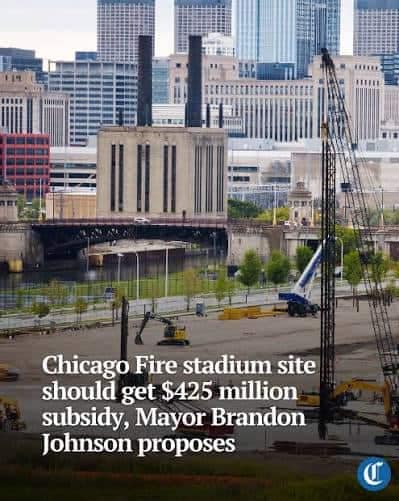
Except, this is all fiction. Taxpayers are very much paying for this project. Two weeks ago, the mayor of Chicago asked the City Council to “approve a $425 million tax increment financing package tied to infrastructure” around the new stadium. According to the Sun-Times, this public money was needed to “unlock Mansueto’s planned (stadium).” As TheRealDeal.com asked in a story, why did city leaders/team executives pitch this project as a “privately financed alternative” to other greedy sports owners when taxpayers will still be forced to invest heavily into this stadium? Wait a second. About that $425M of TIF money. Didn’t the same developer approach the city eight years ago and claim that if a new stadium were built on this land, he would need $450M in infrastructure costs? The city said no and that it was too much money. The developer therefore “promised a substantial reduction” the next time he contacted the city. But his recent offer was $425M. He originally said $450M. Just $25M less? Was that his substantial reduction?
To make matters worse, it is highly doubtful that taxpayers will see any revenue from these infrastructure costs, for example new parking lots. Whenever I see quotes like “Revenue-sharing details have not been finalized”, it tells me that the team will take every single revenue dollar. The team simply doesn’t want to mention that to the public right now. Furthermore, aren’t the Fire receiving almost $10M per year from McDonald’s for stadium naming rights? Can’t they use that money for their own infrastructure costs?
Thankfully, the Chicago Fire do not have a history of screwing over taxpayers. Oh wait, they do? In 2006, the Chicago Fire opened their new stadium in Bridgeview, Illinois (15 miles from Chicago).
Taxpayers were promised that:
This venue would become an “economic anchor…that would pay for itself and spur development around it.”The maximum amount of taxpayer money spent on this project would be no more than $55M.There was no way for taxpayers to lose money on this deal.
How did this work out?
The stadium had zero impact on the surrounding area and was a drain on taxpayers for many years.The total cost to taxpayers for this stadium was at minimum $250M.The mayor paid a company to write a report that stated how the stadium’s worst-case scenario, financially speaking, had the city breaking even. Like every other paid-for report done by teams or proponents of new venues, the facts of the paper were never based in reality.
None of that ever happened and the stadium never “hit the economic goal promised by its proponents.” Local leaders were forced to deal with annual losses of $4M-$5M while residents saw their property taxes raised three times in just 10 years.
A report by Standard & Poor estimated that each Bridgeview resident’s share of the debt burden was approximately $18,000. The city’s credit rating was drastically reduced to mere junk-bond status.
Back to today, it appears some in the Chicago community are pushing back on giving any taxpayer money to the new Chicago Fire stadium or any of its outside costs.


