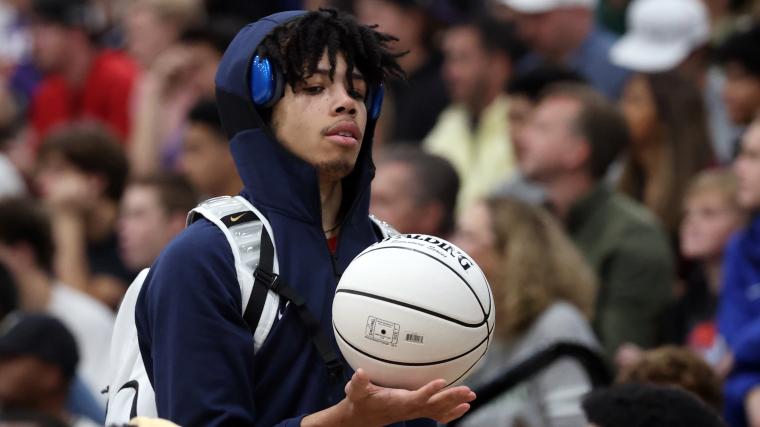
STORRS — Solo Ball was in the midst of one of his best games, a 26-point performance against Butler at Peoples Bank Arena on Dec. 16. Things changed in an instant, even if he didn’t realize it in the moment.
“I took a tough fall in the first half,” Ball said. “My leg got undercut, and I didn’t really know how to land and I just got caught in between. I really played the rest of the game on adrenaline, I don’t really know how I did it, to be honest with you. Scored a bunch after that, don’t know how. Without adrenaline and some bio-freeze, I probably wouldn’t have gotten through it.”
Ball sat out the next game, at DePaul, with what was then termed a “minor wrist injury.” When he returned, after a two-week layoff, he hit 6 of 10 from the floor vs. Xavier on New Year’s Eve. But a painful, frustrating and difficult couple of months lay ahead. His shooting stroke never looked the same, or produced the usual results, as he went 12 for 34 from the floor, 1 for 13 on 3-pointers the next three games.
Dom Amore’s Sunday Read: This CT coach driving for NCAA lacrosse championship three-peat, and more
“He’s a tough guy, he wasn’t vocal about it too much when it first happened,” teammate Jayden Ross said. “He was a little frustrated with it, you could tell it was nagging him a little bit. You know there’s something up when the shot wasn’t necessarily the same, you’d see it, he would shoot and not flick his wrist too much. Normally, he’s such a great shooter, when he shoots the ball, you’re like, ‘It’s going in.’ He never brought it up, never complained about it.”
On some days the wrist felt better and he shot a little more like Solo Ball, on others neither adrenaline nor topical solutions could ease the pain or buy him a bucket. He finished the season with a 39.2 shooting mark from the floor, 30 percent in threes.
“It didn’t know how bad it was at first,” Ball said. “But one thing about me, I was just going to push through and fight for my team. That’s really all I was thinking about every time I stepped on the floor. There wasn’t really a time when I didn’t feel it. I just did what I could to manage it. … We got to the national championship game, that’s what we wanted.”
When the season ended, Ball got another MRI to find out once and for all what was wrong with his left wrist. “I was shooting and I could feel stuff moving (in the wrist),” he said. “It was time to check it out.”
Tests revealed two ruptured tendons and brought him to a tough decision. He decided to have corrective surgery, and he will sit all of next year as a redshirt. By his nature, this reality was more painful than the injury.
“I bawled my eyes out a good two, three days,” Ball said. “Got all my tears out. It was eating me alive, the fact I couldn’t put on my jersey that long and suit up for that long. But I’m going to be in the same building with my brothers, not going to change.”
Perimeter shooting is Solo Ball’s signature skill. With this ability disappearing for stretches — he was 9 for 35 on threes in the NCAA Tournament — he heard plenty of groaning from the stands with each miss; felt plenty of social media slings and arrows. But even if he wasn’t shooting like himself, the opponents didn’t need to know that.
“I just didn’t want to draw extra attention to myself,” he said. “There are other teams scouting us, so I didn’t want people messing up the scouting reports. They could chase me off screens and that could open things up for Alex (Karaban), so I’m not telling people about my wrist. I was going to keep playing the game and find other ways to affect it.”
By the championship game, Ball was also playing with a foot sprain. He went 4 for 10 against Michigan, scoring 11 points in 16 minutes. A fully healthy Solo Ball might’ve made a difference there, but then the Huskies drew strength from the example he was setting all along. He could have taken the easier way out, maybe shut it down in January, got the surgery and looked to make his comeback in 2026-27.
“You could just see the pain he was dealing with,” Braylon Mullins said. “It’s just crazy to see that he battled through that the whole year. I’m so happy that he’s getting the treatment, getting it right.”
There is a rule around the program, which has been to three NCAA finals in four years. The basketball season is “we time,” the offseason is “me time.” The time to look at the transfer portal, consider options or, in Ball’s case, get his wrist fixed and heal. The timeline is murky. Ball will get the surgery after exams, then it will be at least six months before he will be able to do any shooting at all. It could nine months to a year to fully heal. Ball has chosen to play the long game, bank on a full, healthy season in 2027-28 and make sure the left wrist is all right for a long pro career.
This much was never in doubt: He will play his remaining collegiate time at UConn; he has too much time, work — and pain — invested to start over somewhere else.
“Man, this is home,” Ball said. “Every time I look at UConn, see those five letters, see a Husky, I can’t see myself anywhere else, can’t see myself walking around anywhere else, driving around anywhere else. I drive around campus, I think to myself, ‘I just can’t see myself anyplace else. ‘This place means the world to me.”