The sports recruiting software market was valued at $1.31 billion in 2025, projected to reach $3.43 billion by 2035 at a CAGR of 10.1%. The space breaks into four distinct technology layers.
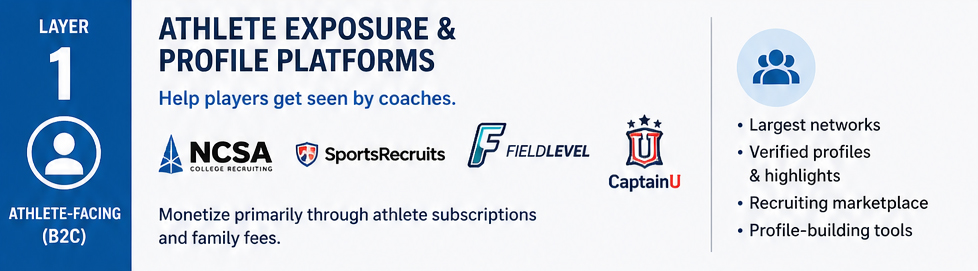
Layer 1 — Athlete Exposure & Profile Platforms (B2C, athlete-facing)
These platforms help players get seen by coaches. Key players include NCSA (largest network), SportsRecruits (verified profiles & highlights), FieldLevel (recruiting marketplace), and CaptainU (profile-building). They monetize primarily through athlete subscriptions and family fees.
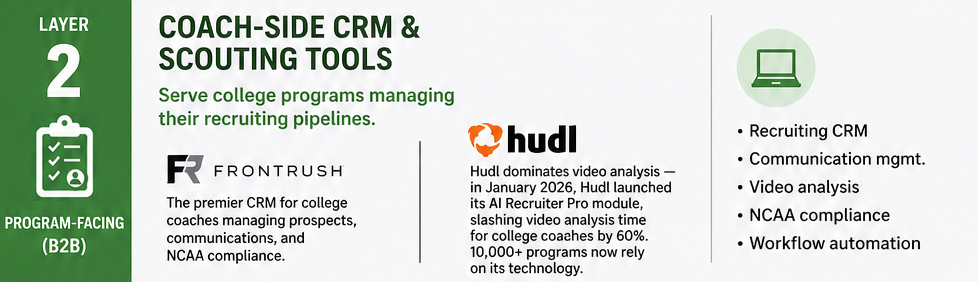
Layer 2 — Coach-Side CRM & Scouting Tools (B2B, program-facing)
These tools serve college programs managing their recruiting pipelines. Front Rush is the premier CRM for college coaches managing prospects, communications, and NCAA compliance. Hudl dominates video analysis — in January 2026, Hudl launched its AI Recruiter Pro module, slashing video analysis time for college coaches by 60%, with 10,000+ programs now relying on its technology.
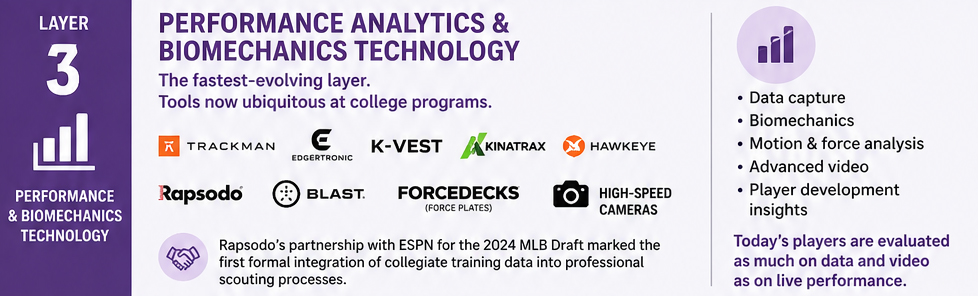
Layer 3 — Performance Analytics & Biomechanics Technology
The fastest-evolving layer. Tools now ubiquitous at college programs include TrackMan, Edgertronic, K-Vest, Kinatrax, Hawkeye, Rapsodo, Blast Motion sensors, high-speed cameras, and force plates. Rapsodo’s partnership with ESPN for the 2024 MLB Draft marked the first formal integration of collegiate training data into professional scouting processes. Today’s players are evaluated as much on data and video as on live performance.
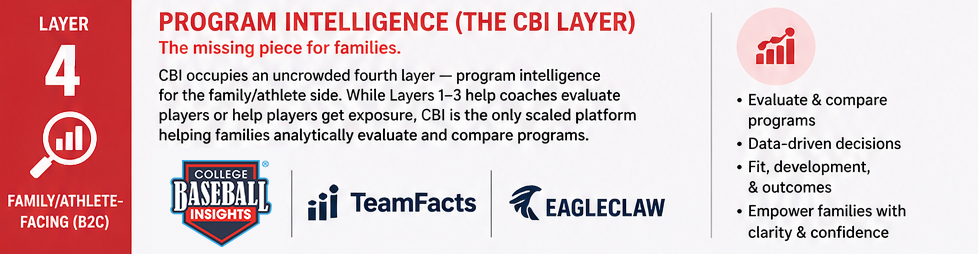
Layer 4 — Program Intelligence (the CBI Layer)
CBI occupies an uncrowded fourth layer — program intelligence for the family/athlete side. While Layers 1–3 all help coaches evaluate players or help players get exposure, CBI is the only scaled platform helping families analytically evaluate and compare programs.
The Program Intelligence Layer — Detailed Analysis
The Core Problem: Data Asymmetry
The program intelligence layer addresses one of the most structurally important problems in college baseball recruiting — data asymmetry. College coaches have access to robust performance data on prospective players through Perfect Game and similar organizations. That same level of transparency is not available for players who want to understand how programs actually operate. When making important college decisions, student-athletes rely on first impressions, official visits, and word of mouth — the least reliable forms of information for a decision of this magnitude.
What Program Intelligence Platforms Track
Roster Composition & DepthHow many players occupy the recruit’s position? What are the class years? Is there a genuine path to playing time, or is the position already stacked for three years
Roster Turnover & Retention RatesPrograms that consistently recruit from specific regions or favor transfers over high school athletes create patterns families can study. Understanding recruiting tendencies is now essential strategic intelligence.
Coaching StabilityCoaching turnover is one of the most underappreciated risks in recruiting. A player commits to a coach, not just a school — and if that coach leaves, the scholarship and fit can evaporate overnight.
Transfer Portal ActivityHow heavily does a program rely on portal players versus developing freshmen? This directly impacts playing time probability for incoming recruits.
Academic & Financial FitProgram intelligence also encompasses institutional data — acceptance rates, majors offered, cost of attendance, scholarship structures — layered against athletic program data.
Competitive Landscape of the Program Intelligence Layer
College Baseball Insights (CBI)
Founded 2017. Category pioneer. Covers 1,700+ colleges. Subscription at $149.99/year. Winner of 23rd Annual Best of Show at 2022 ABCA Convention. Positions itself as the ‘Carfax of baseball recruiting.’
TeamFacts
Aggregates roster composition, retention patterns, recruiting needs, and multi-year program trends across NCAA and NAIA programs. Database contains 330,000+ roster data points across 1,100+ programs built from verified roster postings.
Eagleclaw Analytics
Data-driven approach providing tools and insights including analysis of recruiting tendencies, roster construction, and position-level opportunity mapping for families navigating the recruiting landscape.
Bottom Line:
The college baseball recruiting ecosystem is a multi-billion-dollar industry growing at roughly 9–11% CAGR across its key verticals. The program intelligence layer is the most structurally defensible niche in the entire recruiting software ecosystem because it solves a problem no other vertical addresses: giving the family side of the transaction the same quality of information the coach side has always had. CBI is the category pioneer. The space is now attracting 2–3 competitors, validating the market — but it remains early, underfunded relative to other verticals, and sitting directly in the path of the broader $1.31B–$3.43B recruiting software wave.