
Max Kellerman’s latest praise for Edgar Berlanga is already drawing criticism from boxing observers, with some accusing the veteran broadcaster of acting as “the ultimate shill” for fighters aligned with Zuffa Boxing.
Speaking during a press conference about recent Zuffa signings, Kellerman offered a lengthy defense of Berlanga’s career, describing the Puerto Rican contender as a fighter who became “the victim of his own success” following his remarkable run of first-round knockouts.
The streak that built Berlanga
Kellerman pointed out that Berlanga began his professional career with sixteen straight stoppages in the opening round, a run that briefly captured the imagination of fans watching his rise on televised cards.
The broadcaster attempted to place the streak in context by arguing that careful matchmaking is standard practice in boxing.
“Lots of guys are matched easy to start their career, in fact almost every professional boxer ever is built that way,” Kellerman explained.
“Well, how come no one else has scored 16 straight to start their careers, right? I mean, I can name you fighters, I won’t, but I can if you ask. Who went 50 and 0 (Floyd Mayweather), 53 and 0 (Wanheng Menayothin), right? And you know why they got to that, right? But who has scored 16 straight in the first round?”
Kellerman also reflected on how the streak turned into a spectacle during Berlanga’s early appearances on ESPN.
“Watching it on ESPN, I was part of those broadcasts from the studio sometimes. It’s comical actually, like how’s he going to get another guy out in the first round.”
Critics, however, say comments like those reflect a growing pattern around Zuffa broadcasts, where fighters tied to the project are often framed in glowing terms before their performances have fully justified the praise.
Among some fans and media observers, the frustration has been bluntly summed up with the label “ultimate shill.”
Berlanga’s experience gap
Kellerman argued that the knockout streak created unrealistic expectations around Berlanga’s development.
Kellerman said, “He had almost no professional experience. By his seventeenth fight he had virtually no professional experience. How many rounds had he actually fought?”
Berlanga himself acknowledged the downside of the streak when speaking exclusively to World Boxing News.
“In the beginning, it did, because when I knocked everyone out in the first round, I knocked sixteen opponents out in the first round, but I didn’t get the good rounds to get that experience,” Berlanga told WBN.
“So when I started going the distance with these guys, people were saying I was a bum and I’m no good. But I needed those rounds.”
That admission underlines the same development gap Kellerman referenced, but it also mirrors what many in the sport noticed once Berlanga began facing better opposition.
The early knockouts built hype and momentum, but the aura around the streak faded once the matchmaking tightened and the rounds started to pile up.
By that stage, many insiders were already questioning how the approach would hold up once the level of competition caught up.
The Sheeraz knockout warning
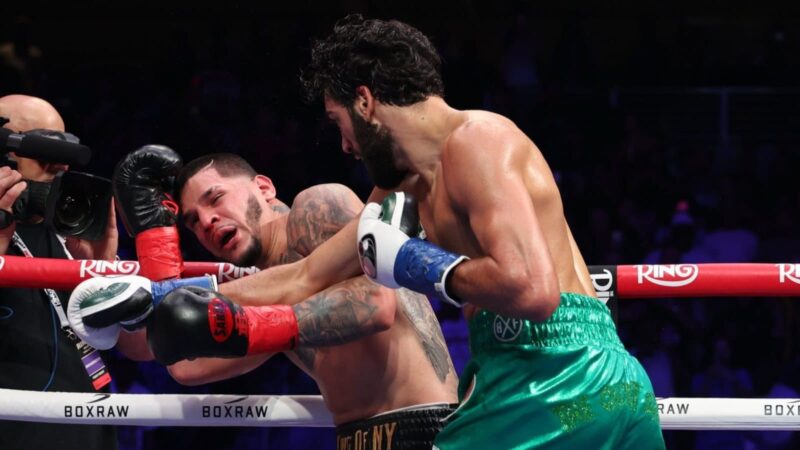
For many observers, the knockout defeat to Hamzah Sheeraz confirmed concerns that had been building long before the opening bell.
Berlanga’s performances leading into the fight had already hinted that the explosive momentum from his early career was becoming harder to reproduce as the opposition improved.
Against Sheeraz, those doubts finally surfaced in dramatic fashion.
Despite that context, Kellerman highlighted Berlanga’s durability by pointing out he managed to go the distance with Canelo Alvarez.
“And then eventually he gets the shot at Canelo Alvarez and goes the distance with Canelo,” Kellerman said.
“That’s very hard to do, especially for aggressive fighters. Canelo is one of the great counter-punchers of all time.”
“Edgar went the distance with him, and that shows something you can’t show from the first-round knockouts. It shows a level of character.”
Kellerman even floated the idea that the knockout artist who built Berlanga’s reputation could still re-emerge.
“Now the question is: is the seek-and-destroy guy still in there who can get everybody out of there?”
A familiar Zuffa pattern
The Berlanga monologue is the latest moment to draw scrutiny since Kellerman became closely associated with the Zuffa Boxing project.
Earlier broadcasts have already sparked debate about the role his commentary now plays within the promotion’s presentation.
During one event, Kellerman suggested Jai Opetaia could already be viewed as “undisputed,” despite the cruiserweight division still having multiple titleholders.
On another occasion, comparisons linking emerging fighters to legends such as Roy Jones Jr. and Larry Holmes prompted Andre Ward to issue a pointed reminder during the exchange.
“You know they’re taking you at your word, verbatim,” Ward said.
For a promotion still establishing itself in the sport, the kind of framing Kellerman is delivering carries real weight.
Many fans and media say the dynamic is now obvious. Kellerman built his reputation as one of boxing’s sharpest independent analysts, which is why the shift in tone has not gone unnoticed.
Some believe the former HBO voice would be better served leaning back toward the more impartial style that made him one of the sport’s most respected commentators.
Whether intentional or not, the result is the same — fighters linked to the project are often introduced with a level of momentum that critics say still needs to be earned inside the ring.
And that tension between promotion and analysis is why Kellerman’s commentary continues to polarize audiences.
About the Author
Phil Jay is the Editor-in-Chief of World Boxing News (WBN) and a veteran boxing reporter with 15+ years of experience. He has interviewed world champions, broken international exclusives, and reported ringside since 2010. Read full bio.


